
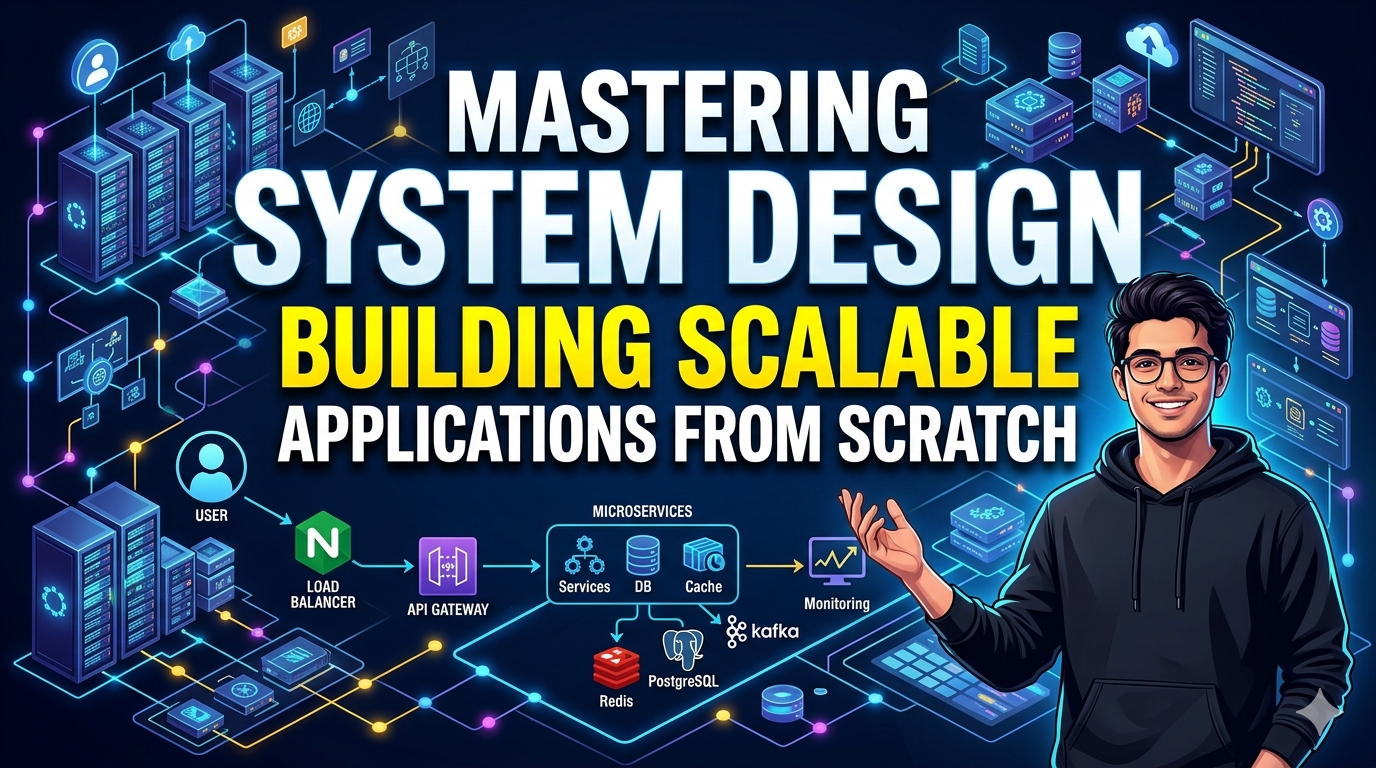
Mastering System Design: Building Scalable and Reliable Applications
System design is the foundation of scalable software architecture. Explore key concepts such as scalability, reliability, load balancing, caching, databases, and distributed systems to understand how modern applications handle millions of users efficiently.
Mastering System Design: Building Scalable and Reliable Applications
Introduction
In today’s digital world, applications are expected to serve millions of users, process enormous amounts of data, and remain available 24/7. Behind every successful platform — whether it’s Netflix, Instagram, or Amazon — lies a strong foundation of System Design.
System Design is one of the most important skills for software engineers because it helps in building applications that are:
- Scalable
- Reliable
- Secure
- High-performing
- Maintainable
In this blog, we’ll explore the fundamentals of system design, core architectural concepts, scalability strategies, and best practices used in modern software engineering.
What is System Design?
System Design is the process of designing the architecture, components, modules, APIs, and data flow of a software application.
It answers critical questions such as:
- How will the system scale?
- How will data be stored?
- How will services communicate?
- How can failures be handled?
- How can performance be optimized?
A well-designed system ensures that applications continue to work efficiently even under heavy traffic and unexpected failures.
Types of System Design
1. High-Level Design (HLD)
High-Level Design provides a macro-level overview of the entire system architecture.
It includes:
- Overall architecture
- Databases
- Load balancers
- APIs
- Service communication
- Caching strategy
Example
Designing the architecture of a video streaming platform like Netflix.
2. Low-Level Design (LLD)
Low-Level Design focuses on implementation details.
It includes:
- Class diagrams
- Database schema
- Design patterns
- Algorithms
- Object relationships
Example
Designing the authentication module for user login.
Core Components of System Design
1. Load Balancer
A Load Balancer distributes incoming traffic across multiple servers.
Benefits
- Prevents server overload
- Improves availability
- Enhances fault tolerance
Popular Tools
- NGINX
- HAProxy
- AWS Elastic Load Balancer
2. Database
Databases are the backbone of every application.
SQL Databases
Best for structured data and strong consistency.
Examples
- MySQL
- PostgreSQL
NoSQL Databases
Best for scalability and flexible schemas.
Examples
- MongoDB
- Cassandra
- DynamoDB
SQL vs NoSQL
FeatureSQLNoSQL
Schema
Fixed
Flexible
Scalability
Vertical
Horizontal
Transactions
Strong ACID
Eventual Consistency
Best For
Structured Data
Large Distributed Systems
3. Caching
Caching stores frequently accessed data in memory to reduce database calls.
Benefits
- Faster response time
- Reduced server load
- Improved performance
Popular Caching Tools
- Redis
- Memcached
4. CDN (Content Delivery Network)
A CDN delivers static content from servers located closest to users.
Benefits
- Reduced latency
- Faster page load
- Better user experience
Popular CDNs
- Cloudflare
- Akamai
- AWS CloudFront
5. Message Queues
Message queues enable asynchronous communication between services.
Benefits
- Decoupled architecture
- Better scalability
- Increased reliability
Popular Technologies
- Apache Kafka
- RabbitMQ
- Amazon SQS
Scalability in System Design
Scalability determines how efficiently a system handles increasing traffic.
Vertical Scaling
Increasing the power of a single machine.
Example
Adding more RAM or CPU.
Limitation
Eventually hardware reaches its maximum capacity.
Horizontal Scaling
Adding more servers to distribute traffic.
Benefits
- Better fault tolerance
- Unlimited scaling potential
- Preferred in cloud-native systems
Monolithic vs Microservices Architecture
FeatureMonolithicMicroservices
Deployment
Single Unit
Independent Services
Scalability
Difficult
Easy
Maintenance
Complex
Easier
Failure Impact
Entire App
Isolated Service
Technology Stack
Fixed
Flexible
Monolithic Architecture
All components are tightly coupled into one application.
Advantages
- Simpler deployment
- Easier initial development
Disadvantages
- Difficult scaling
- Hard maintenance
Microservices Architecture
Application is divided into multiple independent services.
Advantages
- Independent deployment
- Better scalability
- Flexible technology choices
Disadvantages
- Increased complexity
- Challenging debugging
Understanding CAP Theorem
The CAP Theorem states that a distributed system can guarantee only two out of the following three:
- Consistency
- Availability
- Partition Tolerance
CP Systems
Focus on:
- Consistency
- Partition tolerance
Examples
- HBase
- MongoDB
AP Systems
Focus on:
- Availability
- Partition tolerance
Examples
- Cassandra
- DynamoDB
Database Sharding
Sharding divides large databases into smaller partitions called shards.
Benefits
- Improved performance
- Better scalability
- Reduced load on individual servers
Example
User IDsServer
1–1M
Server A
1M–2M
Server B
Replication
Replication creates multiple copies of data across servers.
Types of Replication
Master-Slave Replication
- Writes go to master
- Reads go to replicas
Master-Master Replication
- Multiple writable nodes
Benefits
- High availability
- Disaster recovery
- Faster reads
Real-World Example: Designing a URL Shortener
Let’s understand system design with a practical example.
Requirements
- Convert long URLs into short links
- Redirect users instantly
- Handle millions of requests
- Track analytics
High-Level Architecture
Components
API Layer
Handles incoming requests.
Database
Stores URL mappings.
Cache
Stores frequently accessed URLs.
Load Balancer
Distributes traffic across servers.
Analytics Service
Tracks clicks and user behavior.
System Design Interview Tips
1. Clarify Requirements
Understand:
- Functional requirements
- Non-functional requirements
- Scale expectations
2. Estimate Traffic
Estimate:
- Daily active users
- Requests per second
- Storage requirements
3. Design APIs
Example APIs:
POST /api/v1/shorten
GET /api/v1/{shortId}
4. Discuss Trade-Offs
Every architectural decision involves trade-offs.
Examples
- SQL vs NoSQL
- Consistency vs Availability
- Monolith vs Microservices
Best Practices in System Design
Keep It Simple
Avoid unnecessary complexity.
Design for Failure
Failures are inevitable.
Use:
- Retries
- Circuit breakers
- Redundancy
Monitor Everything
Use monitoring tools like:
- Prometheus
- Grafana
- ELK Stack
Optimize Incrementally
Premature optimization can increase complexity.
Future Trends in System Design
Serverless Computing
Platforms like AWS Lambda reduce infrastructure management.
Event-Driven Architecture
Applications react to events asynchronously.
AI-Driven Infrastructure
AI systems automatically optimize scaling and resource allocation.
Edge Computing
Processing data closer to users reduces latency.
Conclusion
System Design is more than just drawing architecture diagrams — it’s about building applications that can survive real-world scale, failures, and growth.
By mastering concepts like:
- Scalability
- Databases
- Caching
- Distributed systems
- Load balancing
You can design robust systems used by millions of users worldwide.
Whether you're preparing for software engineering interviews or building production-grade applications, investing time in system design will significantly improve your engineering skills.
Final Thoughts
The best way to learn System Design is through:
- Building real-world projects
- Studying production architectures
- Reading engineering blogs
- Practicing system design interviews
Great systems are not built overnight. They evolve through thoughtful architecture, continuous improvements, and real-world learning.