
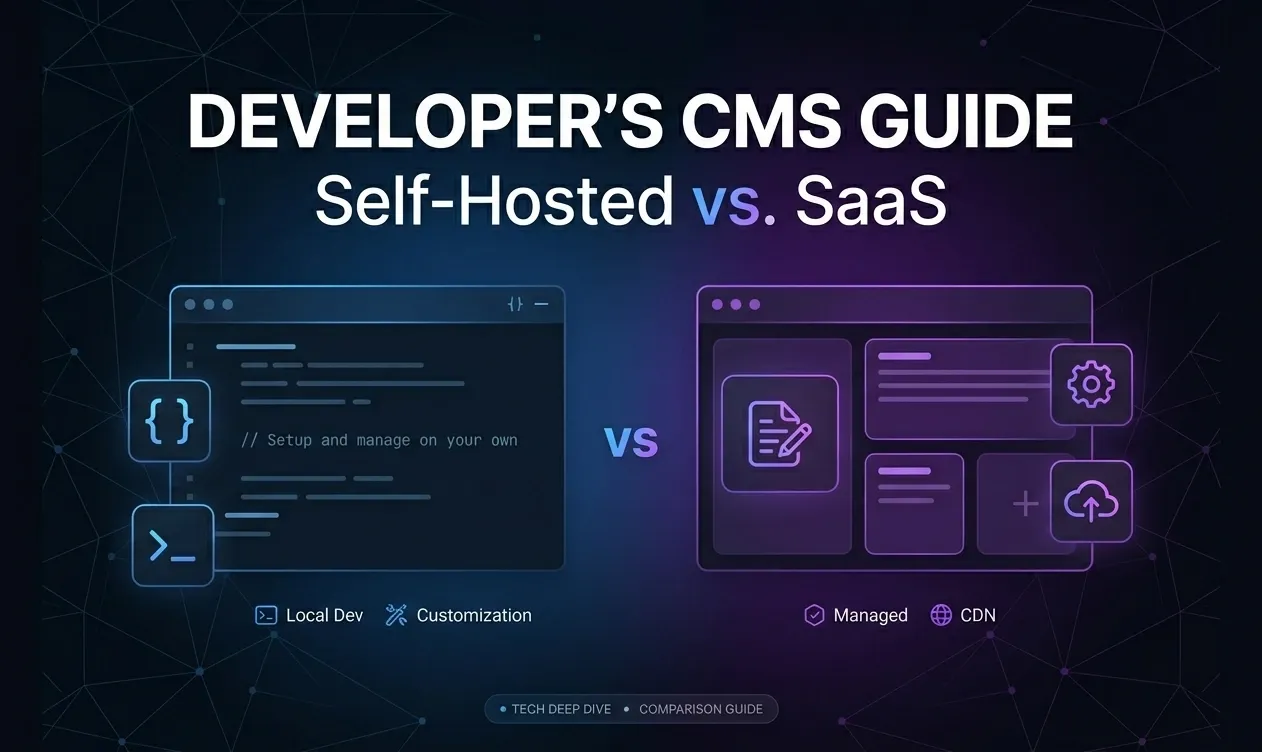
After evaluating both Payload CMS and Contentful, I chose Payload for my portfolio due to its open-source nature, seamless Next.js integration, TypeScript support, and complete control over content and infrastructure. Here's a detailed comparison and the reasoning behind my decision.
Content management systems have evolved significantly over the last few years. With the rise of headless architecture, developers now have more flexibility than ever when building content-driven applications. When I decided to create my portfolio website, I evaluated several headless CMS solutions, with Payload CMS and Contentful emerging as the strongest contenders.
Both platforms are powerful and widely used, but after careful consideration, I ultimately chose Payload CMS. In this article, I'll compare both platforms and explain why Payload CMS was the better fit for my project.
What Are Payload CMS and Contentful?
Contentful
Contentful is one of the most popular cloud-based headless CMS platforms. It provides an intuitive content management interface, APIs for content delivery, and a scalable infrastructure managed entirely by Contentful.
Developers can focus on building applications while Contentful handles hosting, maintenance, backups, and scaling.
Payload CMS
Payload CMS is an open-source, self-hosted headless CMS built with TypeScript, Node.js, and React. Unlike traditional SaaS CMS solutions, Payload lives inside your application and gives developers complete control over content, authentication, APIs, and database architecture.
It is particularly popular among developers building modern applications with Next.js.
Comparison Overview
Feature | Payload CMS | Contentful |
|---|---|---|
Open Source | ✅ Yes | ❌ No |
Self Hosted | ✅ Yes | ❌ No |
TypeScript Support | ✅ Native | ⚠️ Limited |
Custom Backend Logic | ✅ Full Control | ⚠️ Restricted |
Database Access | ✅ Direct | ❌ Managed by Contentful |
Pricing | ✅ Free to Start | ⚠️ Usage Based |
Next.js Integration | ✅ Excellent | ✅ Good |
Vendor Lock-In | ✅ Minimal | ❌ Higher |
Hosting Responsibility | ❌ Yours | ✅ Managed |
1. Full Ownership of Data
The biggest reason I selected Payload CMS was data ownership.
With Contentful, all content is stored on Contentful's infrastructure. While this works well for many teams, it creates a dependency on a third-party service.
Payload stores content directly in your own database.
This means:
- Complete control over data
- No platform lock-in
- Easier migration
- Custom database queries when needed
- Freedom to choose hosting providers
For a personal portfolio, owning the entire stack was a major advantage.
2. Better Developer Experience
As a developer, I spend most of my time working in code.
Payload adopts a code-first approach where collections, fields, access controls, and relationships are defined directly in TypeScript.
Example:
export const Blogs: CollectionConfig = {
  slug: 'blogs',
  fields: [
    {
      name: 'title',
      type: 'text',
      required: true,
    },
  ],
}
Everything lives in version control.
With Contentful, content models are usually created through the dashboard. While user-friendly, it can make collaboration and change tracking more difficult for developer-focused projects.
Payload feels like building software.
Contentful feels like configuring software.
3. Native TypeScript Support
Modern web development heavily relies on TypeScript.
Payload generates TypeScript types automatically from your collections.
For example:
import { Blog } from '@/payload-types'
This provides:
- Type safety
- Better autocomplete
- Reduced runtime errors
- Improved developer productivity
Since my portfolio uses Next.js and TypeScript, Payload's first-class TypeScript support significantly improved the development experience.
4. Seamless Integration with Next.js
My portfolio is built using Next.js.
Payload integrates extremely well with Next.js because both technologies can run together within the same application.
Benefits include:
- Shared TypeScript types
- Server-side data fetching
- Unified deployment
- Better performance
- Simpler architecture
With Contentful, I would need to communicate with external APIs every time content was fetched.
With Payload, content is available directly within the application.
5. Cost Efficiency
Pricing is another area where Payload stood out.
Contentful Pricing Considerations
Contentful offers a free plan, but costs increase as:
- Content volume grows
- API usage increases
- Team size expands
- Advanced features are required
For personal projects and independent developers, these costs can become significant over time.
Payload Pricing
Payload itself is free and open source.
The primary costs are:
- Hosting
- Database
- Storage
Since many developers already pay for hosting infrastructure, the additional expense is often minimal.
For my portfolio, Payload was the more cost-effective option.
6. Greater Customization
One of Payload's strongest advantages is flexibility.
Because Payload runs inside your application, you can:
- Create custom endpoints
- Add custom authentication logic
- Extend the admin panel
- Build custom workflows
- Implement advanced permissions
Contentful provides customization options, but they are naturally limited by the SaaS environment.
Payload gives developers significantly more freedom.
7. Single Codebase Architecture
A feature I particularly appreciate is having everything in one repository.
My portfolio contains:
- Frontend
- CMS
- Database configuration
- API routes
- Authentication
- SEO settings
all managed within a single project.
This simplifies:
- Deployment
- Maintenance
- Debugging
- Scaling
With Contentful, the CMS exists as a separate service, introducing additional complexity.
8. Modern Open-Source Ecosystem
Open-source software offers transparency and flexibility.
Payload's open-source nature means:
- Community contributions
- Faster innovation
- No vendor restrictions
- Ability to inspect source code
- Long-term sustainability
As developers increasingly value ownership and flexibility, open-source solutions like Payload are becoming more attractive alternatives to SaaS platforms.
When Contentful Might Be the Better Choice
Despite choosing Payload, Contentful remains an excellent product.
Contentful may be the better option if:
- You don't want to manage infrastructure
- Your team includes many non-technical editors
- You need enterprise support
- You want a fully managed solution
- Your organization already uses Contentful
For large content teams, Contentful's managed experience can be a significant advantage.
Final Thoughts
Both Payload CMS and Contentful are powerful headless CMS platforms capable of supporting modern applications.
For my portfolio, however, Payload CMS aligned better with my goals:
- Full ownership of content and infrastructure
- Strong TypeScript support
- Excellent Next.js integration
- Lower long-term costs
- Greater customization
- Open-source flexibility
Contentful excels as a managed SaaS platform, but Payload CMS offers a level of control and developer experience that is difficult to match for modern full-stack applications.
If you're building a portfolio, personal project, startup MVP, or developer-focused application with Next.js, Payload CMS is definitely worth considering.